T20 World Cup 2026 Visa Row: India Blocks Pakistan-Born Cricketers | SportInsiderly
Visa uncertainty clouds the T20 World Cup 2026 Visa Row: India Blocks Pakistan-Born Cricketers | SportInsiderly. Full details, affected teams and what it means for global cricket.
CRICKET
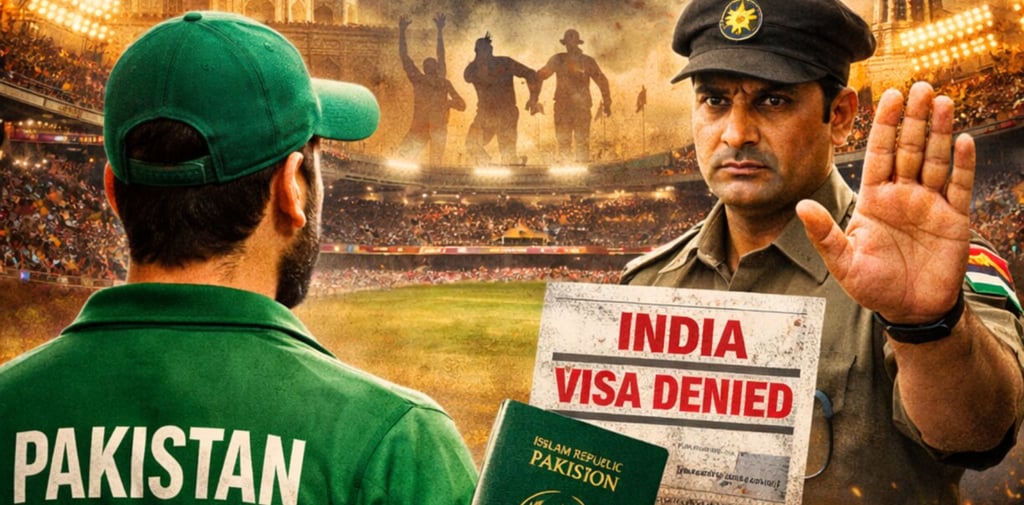
T20 World Cup 2026 Visa Row: India Blocks Pakistan-Born Cricketers
The ICC Men’s T20 World Cup 2026 was meant to be a celebration of cricket’s global reach — a tournament where talent rises above borders. Instead, weeks before the first ball is bowled, the competition is being overshadowed by a growing visa controversy involving Pakistan-born cricketers.
According to multiple sources, cricketers of Pakistani origin or those holding Pakistani passports may face serious difficulties in obtaining Indian visas ahead of the tournament. The uncertainty has triggered concern across several participating nations and raised uncomfortable questions about fairness, inclusivity, and governance in modern cricket.
What Is the T20 World Cup 2026 Visa Issue?
The controversy centres on India’s visa policy for players with Pakistani backgrounds. Reports suggest that the cricket boards of five participating teams have formally approached the International Cricket Council (ICC) to seek clarity.
However, despite repeated communication, these boards have reportedly received no official assurance from either the ICC or the Board of Control for Cricket in India (BCCI).
🔗 Learn more about the tournament via the ICC Men’s T20 World Cup
🔗 Role of the governing body explained at International Cricket Council
🔗 Host board details at BCCI Official Website
Teams Directly Affected by the Visa Uncertainty
Several associate nations rely heavily on players from multicultural backgrounds. The teams reportedly impacted include:
United Arab Emirates (UAE) – 🔗 Emirates Cricket Board
Oman – 🔗 Oman Cricket
Italy – 🔗 Federazione Cricket Italiana
Canada – 🔗 Cricket Canada
United States of America (USA) – 🔗 USA Cricket
Many of these squads include players who are either Pakistani passport holders or of Pakistani descent, placing them at risk of visa delays or denials.
Why This Issue Is So Significant
Cricket history shows that sports and politics often collide, especially in South Asia. The strained India–Pakistan relations have previously impacted bilateral cricket, visa access, and player movement.
Anecdote from the Past
During a previous ICC event hosted in India, an associate nation player of Pakistani origin reportedly received his visa after the team had already exited the tournament. Despite months of preparation, his World Cup dream ended not on the field — but at an embassy desk.
That memory still lingers, and it explains why associate boards are sounding the alarm early this time.
Why Associate Nations Are Most Vulnerable
Unlike full-member teams, associate nations operate with:
Limited player pools
Smaller budgets
Fewer replacement options
For teams like Canada and USA, diaspora players form the backbone of competitiveness. Losing even one key cricketer due to visa issues can completely disrupt team balance, match strategy, and morale.
🔗 Read about associate cricket development via ICC Development Programme
Silence from ICC and BCCI: A Growing Concern
While the ICC is responsible for ensuring equal participation, host nations control visa facilitation. So far:
The ICC has not issued a public guarantee
The BCCI has not clarified India’s visa stance
Affected boards remain in limbo
This silence has added to anxiety, especially with team selections and travel planning already underway.
T20 World Cup 2026: Tournament Overview
The T20 World Cup 2026 will be co-hosted by India and Sri Lanka from 7 February to 8 March 2026.
Key Tournament Structure
20 teams
Five groups of four teams
Top two teams qualify for Super Eight
Super Eight begins on 21 February in Colombo
Final on 8 March in Ahmedabad or Colombo
🔗 Official fixtures and format: ICC Tournament Schedule
Notably, India and Pakistan are drawn in the same group — a fixture that traditionally attracts global attention and massive viewership.


Contact
Have a question, suggestion, or partnership inquiry?
Email:
info@sportinsiderly.com
© 2025. All rights reserved.
🌐 Follow us on social media for daily updates.